Reviewed · BANGKOK TOURS
Bangkok: Hop-On Hop-Off Bus with 24, 48 or 72-Hour Validity
Bangkok is wonderfully hard to read at street level. Temples, malls, markets, and traffic all crowd together, so this double-decker bus loop gives you a useful first look at the city without forcing you into a fixed tour. You can stay aboard for the full circuit, then return to the places that catch your eye.
I like the choice of air-conditioned or open-air seating, especially in Bangkok’s heat, and I like the live bus-tracking app, which helps you avoid standing at an unclear roadside stop for too long. The main caution is traffic: a full circuit can take 2.5 to 3.5 hours, and the final bus leaves in the afternoon, so a 24-hour pass is too rushed if you plan to visit several sights.
Quick points to know
- Sixteen useful city stops: The loop links Siam, Chinatown, the Grand Palace area, Wat Arun, ICONSIAM, Patpong, and other major areas.
- A full circuit takes time: Expect about 3 to 3.5 hours from the first stop to the last, depending on traffic and road closures.
- The 48-hour pass is the sweet spot: It gives you time to get off at the Grand Palace, Wat Pho, Chinatown, and ICONSIAM without racing the clock.
- The bus is narrated by GPS: Pre-recorded commentary is offered in English, Thai, Mandarin, Korean, Spanish, German, and French.
- Stops can be hard to spot: Regular public bus stops may be used, and there is not always a clear hop-on hop-off sign.
- It is transport and sightseeing together: The bus is especially helpful when the heat, distance, or a sore knee makes repeated taxi rides unappealing.
Why this bus works well in sprawling Bangkok
I see this as a city-orientation tool first and a sightseeing ride second. Bangkok’s key sights are not packed into one walkable historic center. Siam’s shopping district, Chinatown, the old temple quarter, the river, and Silom are separated by busy roads and waterways.
The bus connects those areas in one circular route. You can look over the city from the upper deck, listen to the audio guide, and mark the stops worth a second visit. That first circuit can save you from guessing which areas deserve your limited time.
You should not expect a fast shuttle. Bangkok traffic is part of the experience, and sometimes the bus spends more time waiting at intersections than passing monuments. Still, sitting in air conditioning while the city moves around you can be more comfortable than arranging several taxis in the afternoon heat.
The buses begin at Siam Paragon, with departures from the first stop roughly every 35 to 40 minutes between about 10:10 AM and 3:25 PM. Some information gives slightly different departure intervals, so I would check the current timing and the live map before setting out.
A few more Bangkok half-days worth weighing up
- Bangkok: Damnoen Saduak Market and Maeklong Railway Market
★ 4.5 · 26,723 reviews - The Old Siam: Damnoen Saduak and Maeklong Railway Market
★ 4.5 · 10,992 reviews - From Bangkok: Ayutthaya Temples Guided Tour with Lunch
★ 4.7 · 10,535 reviews
Starting at Siam Paragon and the modern city
Siam Paragon is a practical starting point because it is easy to reach by Bangkok’s Skytrain. The boarding counter is on the ground floor at the South Gate, in front of LOCK BOX Plus+, next to Bangkok Bank.
From here, the route passes MBK Center and Samyan Mitrtown. These stops show Bangkok’s modern shopping and dining side rather than its temple quarter. MBK is known for its broad mix of shops, while Samyan Mitrtown is a contemporary mall and lifestyle center.
I would use this opening stretch to get oriented rather than get off immediately, unless you have shopping in mind. The route also passes CentralWorld later, so you have several chances to combine the bus with air-conditioned malls, a useful plan during the hottest part of the day.
Golden Buddha and Chinatown
The Golden Buddha stop serves Wat Trai Mit, home to the famous solid-gold Buddha image. It is one of the route’s strongest temple stops because you can combine a major religious sight with a short walk into Chinatown.
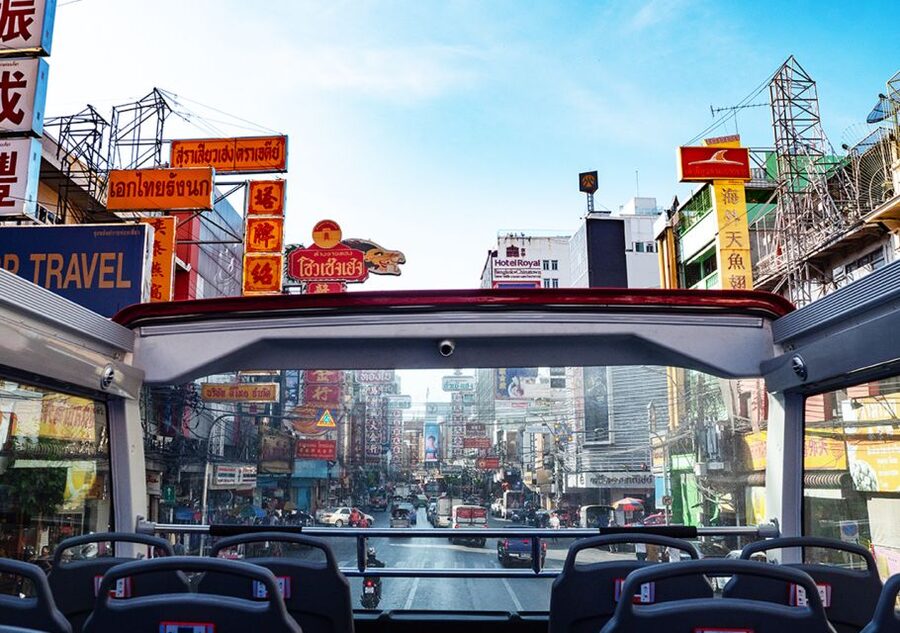
Chinatown is best treated as a neighborhood, not a single attraction. Streets here are packed with shops, food stalls, shrines, and narrow lanes. Allow more time than you think you need if you want to explore properly. If you only get off for a quick photograph, you will miss much of the point.
The Grand China Hotel stop also serves the Chinatown area and the Dragon Temple Kammalawat, a Chinese Buddhist temple. Check the map carefully before leaving the bus, since the stop names refer to nearby landmarks rather than a clearly enclosed attraction entrance.
One practical warning matters here: the stops are not always obvious. You may be using an ordinary public bus stop, with no large red hop-on hop-off sign. Keep the printed map, note the exact pin location, and use the GPS app before walking away from the bus.
Loha Prasat, the Giant Swing, and Khao San Road
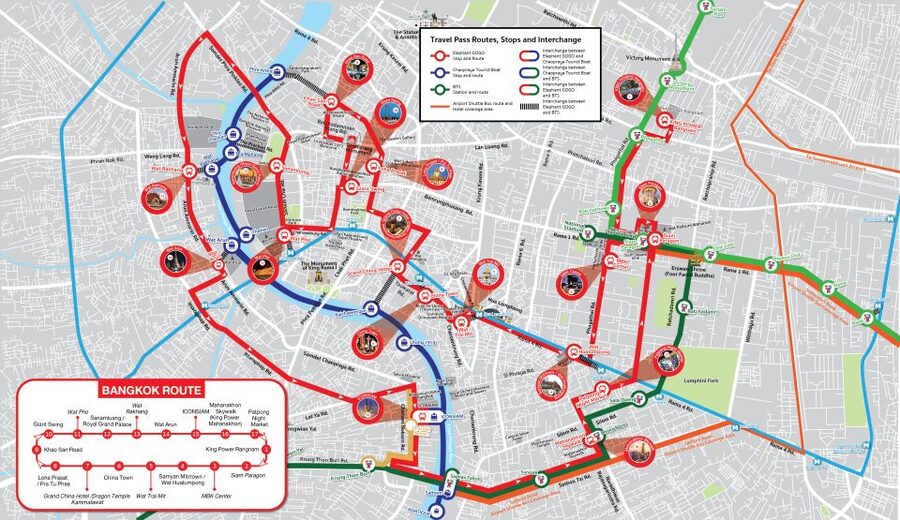
The Loha Prasat and Pra Tu Phee stop puts you near Wat Ratchanatdaram Worawihan, a distinctive temple with a metal-topped structure unlike Bangkok’s more familiar golden stupas. This is a good stop for a quieter architectural break from the city’s biggest sights.
Khao San Road is the route’s most famous backpacker district. It is lively, commercial, and very different from the royal and religious areas nearby. I would not make it the main reason to buy the pass, but it gives you a clear look at one of Bangkok’s best-known nightlife streets.
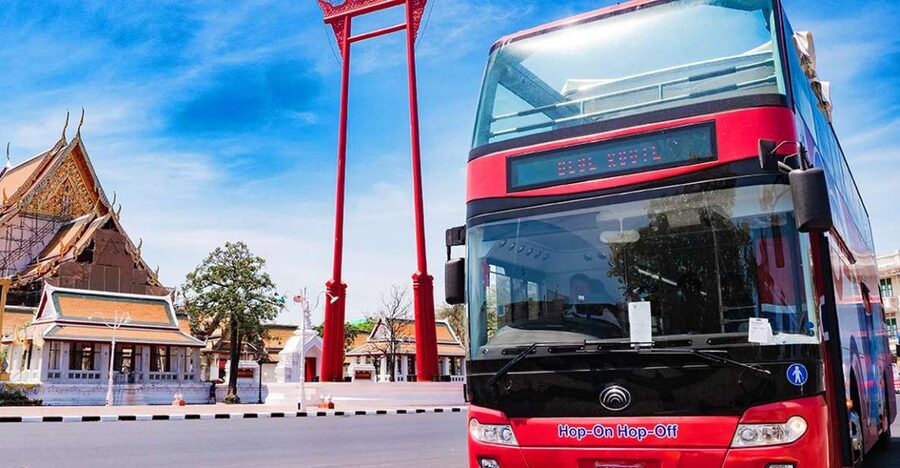
The Giant Swing and Wat Suthat stop is more rewarding for many visitors. Wat Suthat has an elegant interior and a large temple compound, while the Giant Swing provides one of the old city’s instantly recognizable views. This is a sensible place to get off because two worthwhile sights sit close together.
The bus may pause in traffic around the old city, and that can affect your plans. If you have tickets or timed entry elsewhere, build in spare time rather than trusting the published circuit time exactly.
Same base, a completely different kind of day out:
- Bangkok: Train Market & Floating Market with Boat Ride
★ 4.7 · 9,547 reviews - Bangkok Canal Tour: 2-Hour Longtail Boat Ride
★ 4.5 · 5,909 reviews - Bangkok: Muay Thai Boxing Tickets at Rajadamnern Stadium
★ 4.9 · 4,740 reviews - Bangkok: White Orchid Chao Phraya Dinner Cruise free Beer
★ 4.4 · 4,573 reviews
Wat Pho and the Grand Palace area
The Wat Pho stop gives you access to one of Bangkok’s essential temple visits. Wat Pho is associated with the enormous reclining Buddha and with traditional Thai massage teaching. The temple grounds are more than a quick photo stop, so plan enough time to walk through them at an unhurried pace.
The Sanam Luang and Royal Grand Palace stop is another major point on the circuit. Sanam Luang is the broad ceremonial field beside the Grand Palace, and this area places you close to Bangkok’s most important royal complex.
These two stops are where a one-day bus pass can become frustrating. A careful visit to Wat Pho and the Grand Palace can use much of the day, particularly if you stop for food or need a break from the heat. That is why I favor the 48-hour option for anyone who wants to enter several sights instead of simply viewing them from the bus.
Remember that the bus ticket does not include entrance fees, food, or a live guide. The audio system gives general information, but it will not walk you through a temple compound or explain dress rules at the entrance.
Crossing to Wat Rakang and Wat Arun
The Wat Rakang Kositaram stop takes the route into the Thonburi side of Bangkok. This area feels different from the grand shopping districts and the old-city monuments. Wat Rakang is a riverside temple with a more local setting.
Wat Arun, the Temple of Dawn, is one of Bangkok’s most memorable sights. Its tall decorated prang is particularly striking from the river, but the temple is also worth visiting up close. Give yourself time for the approach and for looking around instead of treating it as a quick bus stop.
The route’s river crossings and road conditions can slow the schedule. If Wat Arun is a priority, check the live bus location and avoid assuming the next bus will arrive at the exact advertised minute.
ICONSIAM and the riverfront pause
ICONSIAM is one of the most useful stops on the route for a break. It is a large riverside shopping center with dining and indoor space, which makes it a practical refuge during a hot afternoon or sudden rain.
I would pair ICONSIAM with the bus as a rest stop rather than rush through it. You can eat, cool down, and watch the riverfront before checking the app for the next bus. A few hours can disappear here, so keep an eye on the final departure time.
The riverfront stop also shows how this tour blends old Bangkok with its newer commercial side. In one day, you can move from Wat Pho and Wat Arun to a modern mall without arranging separate transport for every leg.
MahaNakhon, Patpong, and CentralWorld
King Power MahaNakhon is the stop for the MahaNakhon SkyWalk area. This is the modern high-rise face of Bangkok, far removed from the old city temples. The bus only provides access to the area, so any SkyWalk admission would be separate.
Patpong Night Market brings you into Silom. It is a compact evening-oriented stop, though the bus schedule is the important limitation. Since the final bus leaves the first stop in the mid-afternoon, you should not assume the service will carry you deep into the evening.
CentralWorld completes the modern shopping section of the route. There is a second service counter and boarding point here, in front of Hug Thai Gate on the first floor. This can be handy if you are already in the shopping district and do not want to travel back to Siam Paragon first.
Audio guide, seating, and comfort
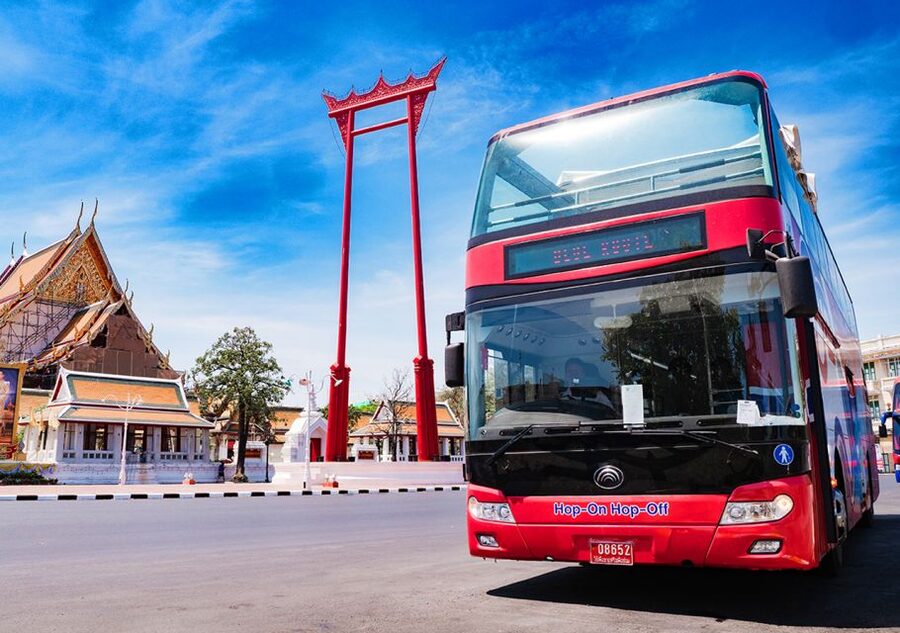
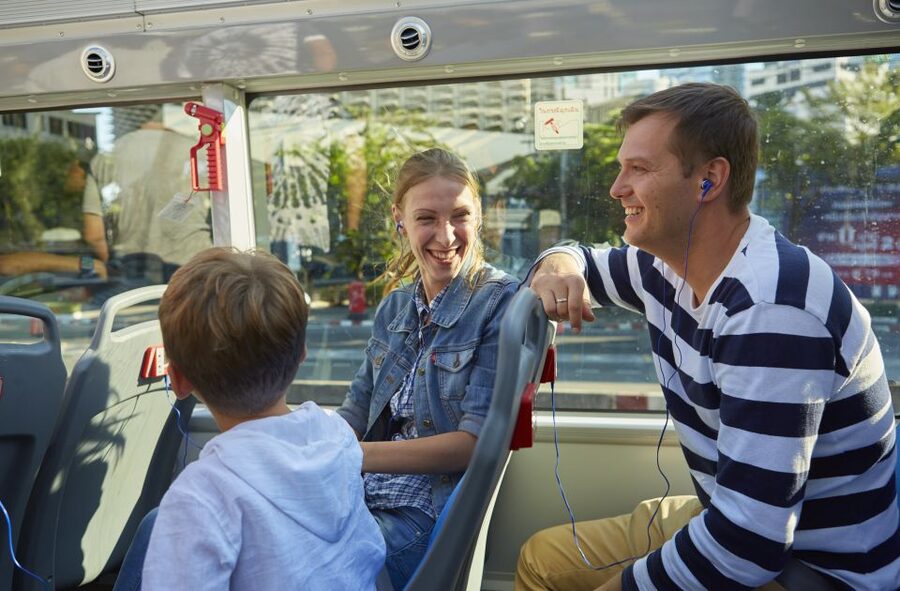
The recorded audio guide is triggered by GPS and plays through free earphones. The seven main audio languages are English, Mandarin, Thai, Korean, Spanish, German, and French.
I find this format useful when I want basic context without following a guide’s pace. The commentary is brief, and some sections can cut off or move on before a point is finished. Treat it as an introduction, not a substitute for a detailed guidebook.
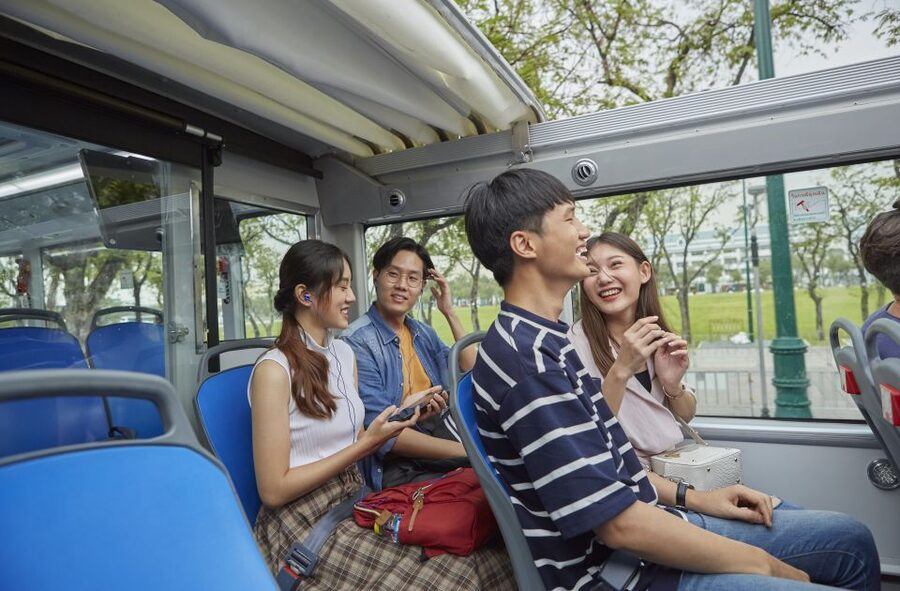
The upper deck offers open-air views, but Bangkok’s sun can be intense. One useful feature is the sheltered or air-conditioned seating option, which gives you a place to cool down. Several experiences with the bus describe it as clean and comfortable, and air conditioning is more than a luxury here.
The bus is wheelchair accessible. Children aged five and under ride free. Food and drinks are not included, so carry water and plan a stop at one of the malls or nearby food areas.
Picking the right pass for your plans
A 24-hour ticket is valid from the time you first board, not simply for the calendar day. If you start at 2 PM on Tuesday, it remains valid until 2 PM on Wednesday, although the buses themselves do not run overnight.
I would choose:
- 24 hours if you want one full circuit, a city overview, and perhaps one or two short stops.
- 48 hours if you want to visit the main temples, Chinatown, and ICONSIAM without racing.
- 72 hours if you prefer a slow schedule, need frequent breaks, or want to spread sightseeing around Bangkok’s heat and traffic.
At $25 per person, the value depends on how often you use it. One complete circuit gives you an overview, but the pass makes more financial sense when you get off several times and use it as transport between districts.
The bus does not replace every Bangkok transport option. The Skytrain, metro, taxis, tuk-tuks, and river boats may be faster for individual journeys. Still, the bus removes some of the planning work and gives you a narrated view along the way.
How to avoid the common problems
Arrive at the stop 10 to 15 minutes early. Traffic, accidents, road closures, and heavy rain can delay the bus, and a full vehicle may not feel as flexible as you hoped.
Before getting off, check the next bus on the mobile app. Do not rely on waving from a random roadside position, especially at the end of the day. Some drivers may stop when they see you, but the formal pickup points are safer.
I would also do the first circuit without getting off if you are new to Bangkok. Mark Chinatown, Wat Suthat, Wat Pho, the Grand Palace, Wat Arun, and ICONSIAM, then decide which ones deserve your time.
Most important, do not spend the whole pass sitting upstairs. The ride gives you a useful map of the city, but Bangkok’s temples, markets, and neighborhoods only make sense when you walk through them.
Who should book this Bangkok bus tour?
I recommend it for first-time visitors, families, older travelers, and anyone who wants an easy introduction to a difficult city. It also suits you if heat, mobility concerns, or unfamiliar streets make a string of independent taxi rides less appealing.
I would hesitate if you have only a few hours and need precise transport. Bangkok traffic can absorb your schedule, and the limited afternoon departure window is a real constraint. Independent transport may be better when you already know exactly which two sights you want.
For most visitors, I would book 48 hours, begin at Siam Paragon, ride one full loop to understand the route, and then use the second day for the stops that matter most. The cancellation policy allows a full refund when you cancel at least 24 hours ahead, and you can reserve now and pay later, which adds useful flexibility.
FAQ
Where does the Bangkok hop-on hop-off bus start?
The main starting point is Siam Paragon. The service counter and bus stop are on the ground floor at the South Gate, in front of LOCK BOX Plus+ and next to Bangkok Bank.
Can I board at CentralWorld?
Yes. A service counter and boarding point is available at CentralWorld in front of Hug Thai Gate on the first floor.
Do I need to exchange my ticket before boarding?
No. Bring your confirmation and show it to the driver or staff at any bus stop. The driver will issue your ticket.
How long is one complete bus circuit?
The full route takes about 3 to 3.5 hours without getting off, depending on traffic and road closures. Some circuits may be shorter or longer in practice.
How often do the buses run?
Buses generally depart every 35 to 40 minutes from the first stop between about 10:10 AM and 3:25 PM. Traffic can cause delays.
Does the ticket work at night?
No. The pass is valid for the selected 24, 48, or 72-hour period from validation, but the bus service does not operate 24 hours.
Which languages are available for the audio guide?
The GPS audio guide is available in English, Mandarin Chinese, Thai, Korean, Spanish, German, and French.
Are entrance fees to temples and attractions included?
No. The ticket includes bus access, the audio guide, earphones, a map or guidebook, and the mobile app. Food, drinks, admission fees, and hotel transfers are not included.
Is the bus wheelchair accessible?
Yes, the activity is listed as wheelchair accessible. Children aged five and under can ride free of charge.
Just added around Bangkok
- Bangkok to Ayutthaya Lopburi Monkey Temple, Largest Buddha Tour★ 5.0 · 62 reviews
- Baiyoke Sky Dinner Experience with Observation Deck Access★ 3.5 · 57 reviews
- Bangkok Luggage Delivery from Hotel to Airport★ 5.0 · 25 reviews
- Living Green Elephant Sanctuary Tour from Bangkok and Pattaya★ 5.0 · 88 reviews
- Bangkok Luggage Storage★ 4.5 · 37 reviews
- Ethical Elephant Watching Tour From Bangkok & Pattaya★ 4.5 · 9 reviews
- Living Green Elephant Sanctuary Experience near Bangkok & Pattaya★ 5.0 · 76 reviews
- King Power MahaNakhon SkyWalk at Bangkok Admission Ticket★ 4.0 · 37 reviews
Bangkok Tours, compared.

Damnoen Saduak Market and Maeklong Railway Market
Read our review →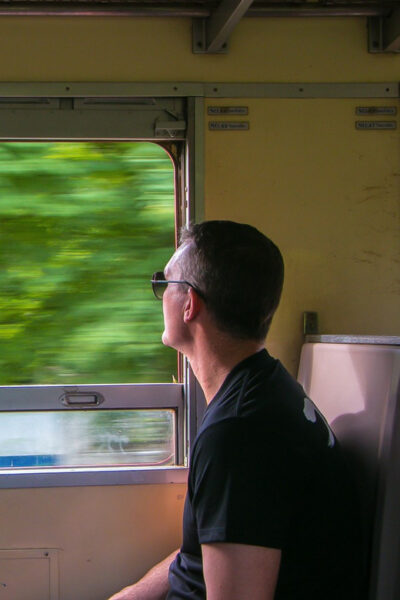
The Old Siam: Damnoen Saduak and Maeklong Railway Market
Read our review →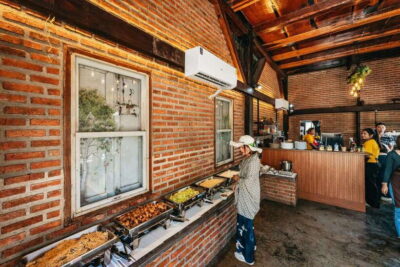
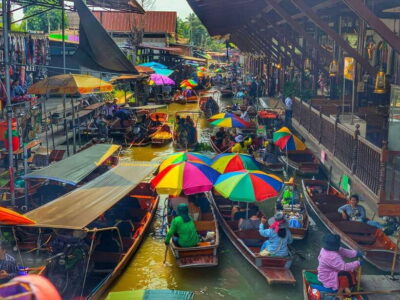
Train Market & Floating Market with Boat Ride
Read our review →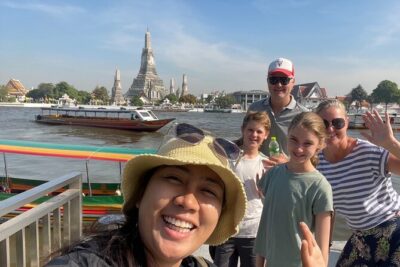
Bangkok Canal Tour: 2-Hour Longtail Boat Ride
Read our review →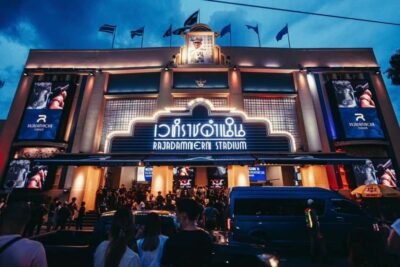
Muay Thai Boxing Tickets at Rajadamnern Stadium
Read our review →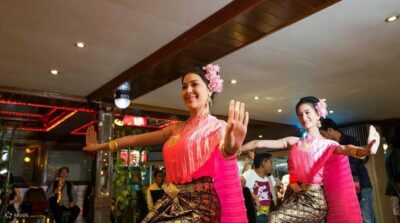
White Orchid Chao Phraya Dinner Cruise free Beer
Read our review →