
Reviewed · AYUTTHAYA TOURS
Colors of Ayutthaya: UNESCO Heritage 6 hour Bicycle Tour
Ayutthaya is easiest to understand from a bicycle. You move between ruined temples, rice paddies, villages, and riverbanks instead of seeing the old capital as a string of disconnected stops. I especially like the country roads before the temples and the riverside lunch, which gives the day a local rhythm rather than making it a nonstop ruin checklist.
The small group, limited to nine people, is another strong point. Guides named Bung, Beam, and Spike have been praised for clear historical explanations, friendly service, and adapting to family needs. The main caution is the heat and the pace of a six-hour ride. Lunch has also been described as tasty but somewhat small, and one recent rider found the English explanations hard to follow.
Key points to know before you book
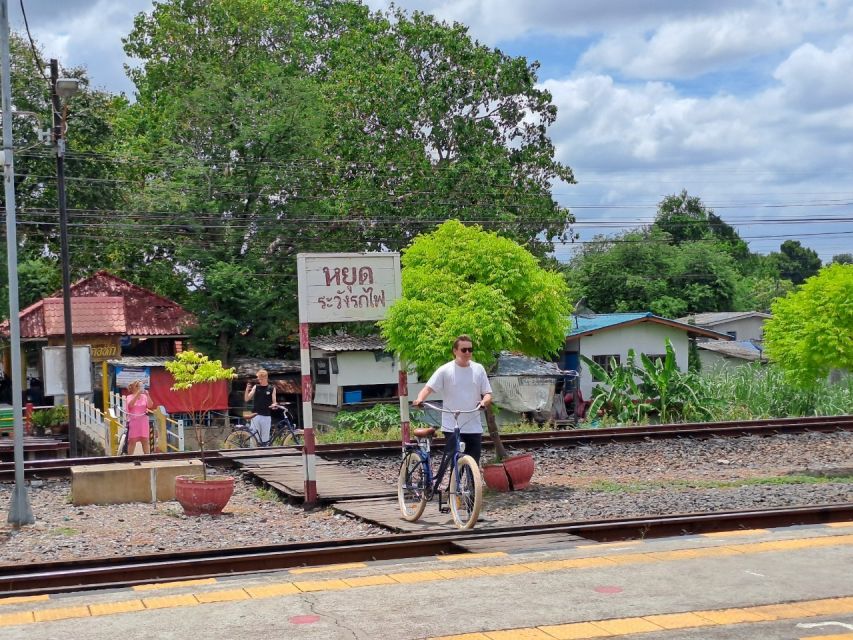
- The ride begins near Ayutthaya train station, making this a practical choice if you arrive by rail.
- You cycle through real countryside, including villages and rice paddies, before reaching the main temple zone.
- The temple lineup is excellent, with Wat Mahathat, Wat Phra Si Sanphet, Wat Lokayasutharam, and Wat Chaiwatthanaram.
- A riverside Thai lunch is included, along with drinking water, bike rental, helmet, entrance fees, and a boat crossing.
- The group is capped at nine people, allowing more room for questions and help on the road.
- The minimum age is 12, and the six-hour schedule calls for a reasonable level of cycling comfort.
Why a bicycle is the right way to see Ayutthaya
Ayutthaya was Thailand’s royal capital from 1350 until its destruction in 1767. Its ruins are spread across an island and surrounding areas, with waterways and roads threading between former palaces, monasteries, and temple compounds.
A vehicle can move you quickly from one major site to another, but it also hides the spaces in between. On this tour, the ride itself becomes part of the visit. You pass rice fields, quiet villages, local roads, and the remains of the old capital at a pace that lets you notice how modern Ayutthaya lives beside its royal past.
You meet your guide at the operator’s office near PomPhet Fort on Uthong Road, a short walk from Ayutthaya train station. The tour starts at 10:00, with a bike fitting before you set out. That fitting matters. A bicycle that feels fine for ten minutes can feel very different after several hours, so take a moment to ask for adjustments before leaving.
The tour lasts 330 minutes, or five and a half hours. The title calls it a six-hour tour, but the stated duration is 330 minutes. Either way, you should keep most of the day free. It is not a quick morning spin.
More Ayutthaya temple days:
- From Bangkok: Ayutthaya Temples Guided Tour with Lunch
★ 4.7 · 10,535 reviews - From Bangkok: Ayutthaya & Ayothaya Floating Market Day Trip
★ 4.7 · 6,084 reviews - From Bangkok: Ayutthaya Historical Park Guided Day Trip
★ 4.6 · 3,020 reviews
Rice paddies, villages, and the first stretch north
The first part follows roads north from the meeting point. This is one of the most appealing parts for anyone who wants more than the standard temple circuit.
You ride through countryside and alongside rice paddies, with the route offering a look at daily life beyond the central ruins. The descriptions provided do not promise a particular cycling surface or traffic level, so you should listen carefully to your guide and stay with the group. Two people may accompany the group, helping riders move safely along the roads.
If it is open, the tour stops at a local elementary school. This is a conditional visit, not a guaranteed one, and school schedules can change. When the school is open, the stop offers a human connection that old stones cannot provide, with a chance to interact with local children.
The school visit may be especially meaningful for families with children aged 12 or older. Still, you should treat it as an added possibility rather than the main reason to book. The central value of the tour remains the cycling route and the historical sites.
The Elephant Kraal and Ayutthaya’s royal power
Along the way, you pass the Phaniat Royal Elephant Kraal. During Ayutthaya’s royal period, this enclosure was used to trap wild elephants that had been driven south from the north.
Ayutthaya’s kings traditionally presided over these roundups and selected strong elephants for war and labor. The stop gives useful context for the kingdom’s military and royal systems, although the experience described here is a pass-by or viewing stop rather than a long elephant-focused visit.
That distinction is important. This is not an elephant encounter or animal attraction. It is a historical site connected to the power of the old kingdom. I prefer that focus. You learn how elephants fitted into Ayutthaya’s political and military life without the tour turning into a modern elephant activity.
As you get closer to the old capital, the ruins become more frequent. The gradual change from farmland to monumental temple remains helps you understand the scale of Ayutthaya as a former capital.
Lunch beside the river at about 12:30
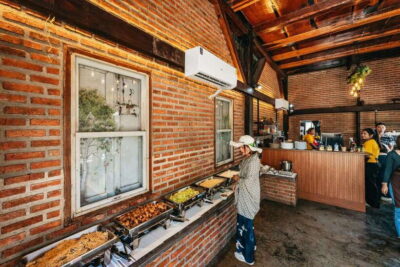
At around 12:30, you stop at a local riverside restaurant for Thai lunch. This is a welcome break after the first section of cycling, and the setting adds something that a meal inside a shopping area would not.
The food has received strong praise, with one rider calling it the best meal they had in Thailand up to that point. Another description found the lunch delicious but noted that the portion was small. I would treat the meal as a proper included lunch, but not as a large feast for a heavy cyclist.
The restaurant setting is one of the tour’s better value points. You get a seated meal, a river view, and time to cool down before entering the busiest part of the historical route. Drinking water is included, and cold drinks were particularly appreciated by one rider.
Thailand’s heat can make the middle of the day demanding, especially in the open areas around the temples. Drink steadily, use the breaks well, and do not save all your water for the next stop. The tour includes water, but you should still arrive ready for a warm outdoor activity.
More history-led days in Ayutthaya:
- UNESCO’s Ayutthaya Historical Park: Full-Day Tour from Bangkok
★ 4.5 · 1,559 reviews - Historical City of Ayutthaya – Unesco Full Day Tour From Bangkok
★ 5.0 · 847 reviews - Private Excursion to Floating Market and Ayutthaya World Heritage
★ 5.0 · 515 reviews - From Bangkok: Ayutthaya Heritage Tour with Sunset Boat Ride
★ 4.5 · 490 reviews
Wat Mahathat and the Buddha head in the roots
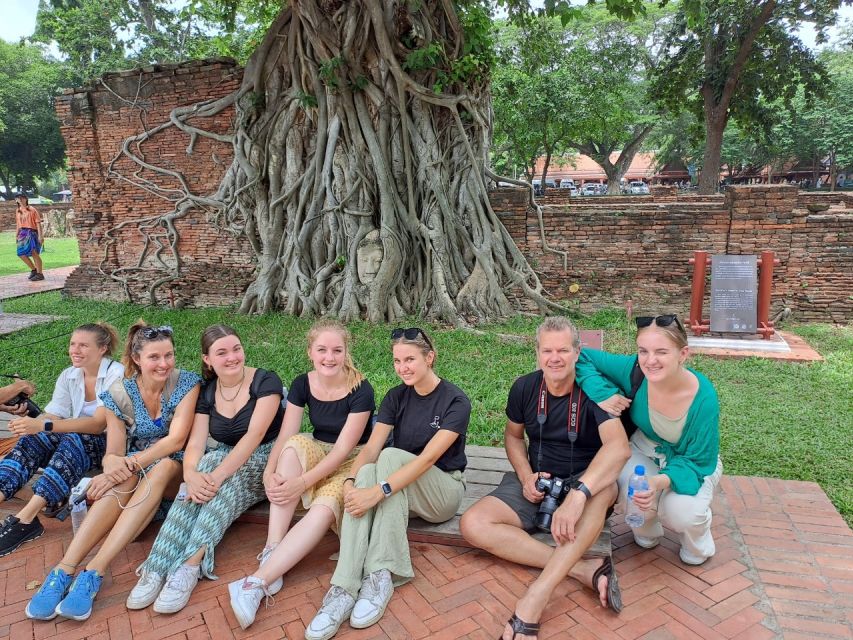
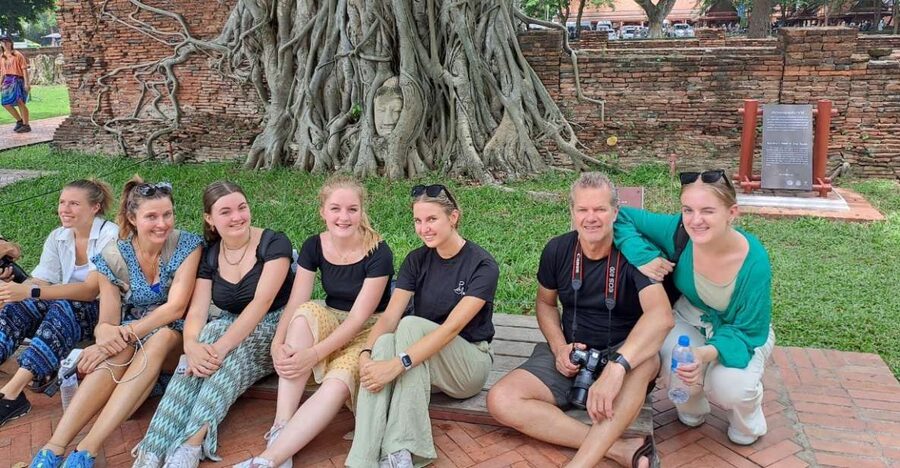
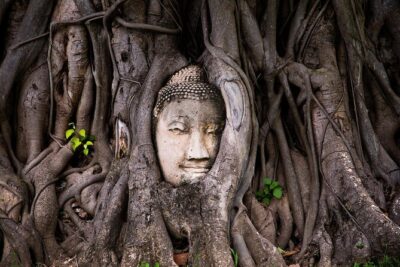
Wat Mahathat is one of Ayutthaya’s essential stops. Its most famous image is the stone Buddha head held within the roots of a tree, a scene that has become a visual symbol of the city.
The image is striking, but the rest of the temple deserves your attention too. Look around at the surviving brick towers, Buddha images, and broken lines of the former religious complex. The ruins show both the scale of the old capital and the damage that followed its fall.
Your guide is an important part of this stop. Without context, the Buddha head can become a quick photograph and little else. A good explanation can help you understand why this temple mattered and how the ruins fit into Ayutthaya’s royal and religious life.
This is also one of the places where the small group helps. With no more than nine participants, it should be easier to hear the guide and ask a question without losing the group.
Wat Phra Si Sanphet and the three pagodas
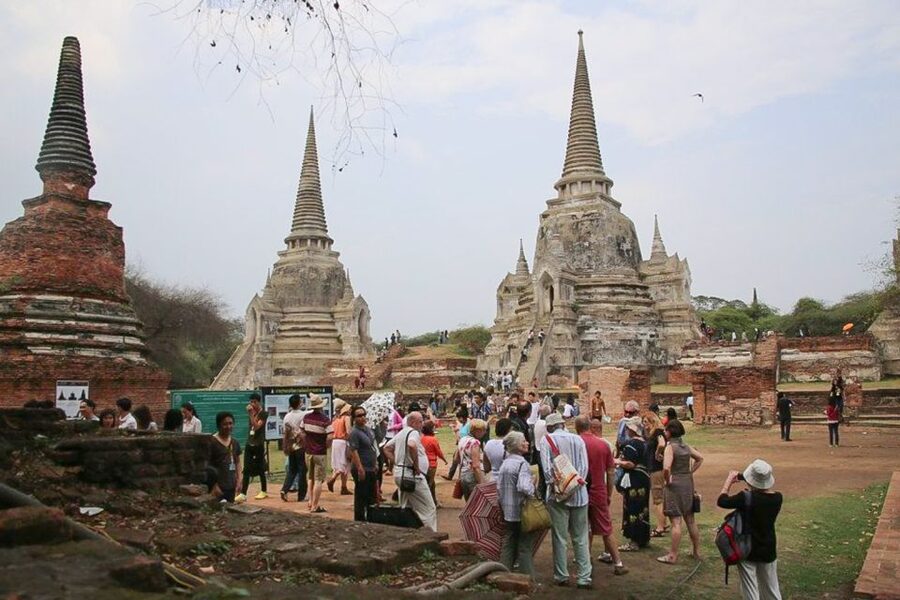
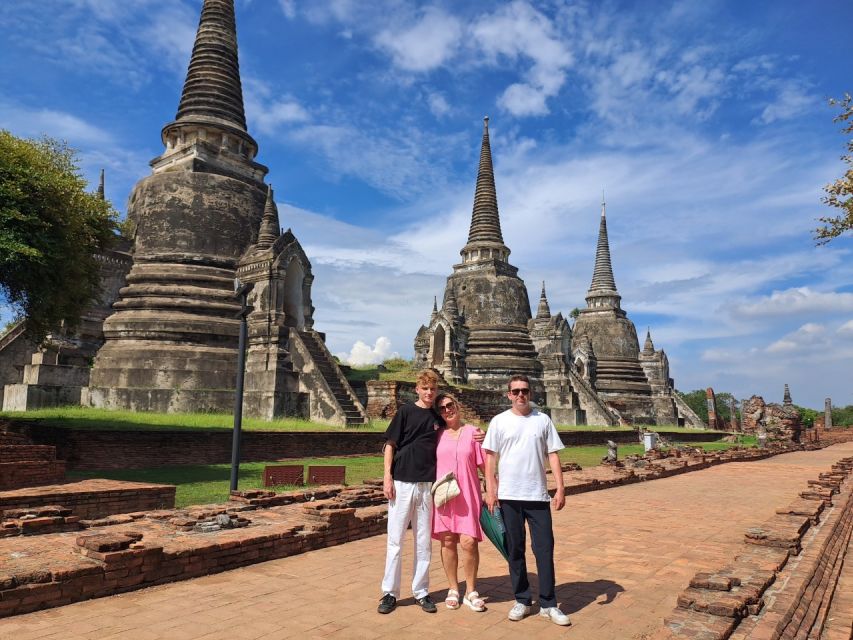
Next comes Wat Phra Si Sanphet, known for its three distinctive pagodas. These chedis once formed part of the royal palace complex and remain among the clearest images of Ayutthaya’s former royal center.
The three towers are not simply another set of temple ruins. Their arrangement gives the site a strong visual order, and the guide can connect them to the kings and ceremonies of the old capital. This is a good place to pause and take in the scale of the former court.
Entrance fees for Wat Mahathat and Wat Phra Si Sanphet are included. That saves you from handling separate payments during a day when the schedule already has several moving parts.
You will likely spend time outdoors on exposed temple grounds. Comfortable clothing, sun protection, and shoes suited to cycling and walking are sensible choices. The supplied information does not list a dress code, so follow your guide’s instructions at each religious site.
A market stop and the reclining Buddha
After the main royal temples, the tour makes a short ride to a local market. The point is not a major shopping session. You go to see typical baked and fried local delicacies and get a glimpse of everyday food culture.
This small stop helps balance the grand ruins. Ayutthaya is not only a former capital preserved in brick and stone. It is also a living town with ordinary markets, snacks, restaurants, schools, and homes around the archaeological area.
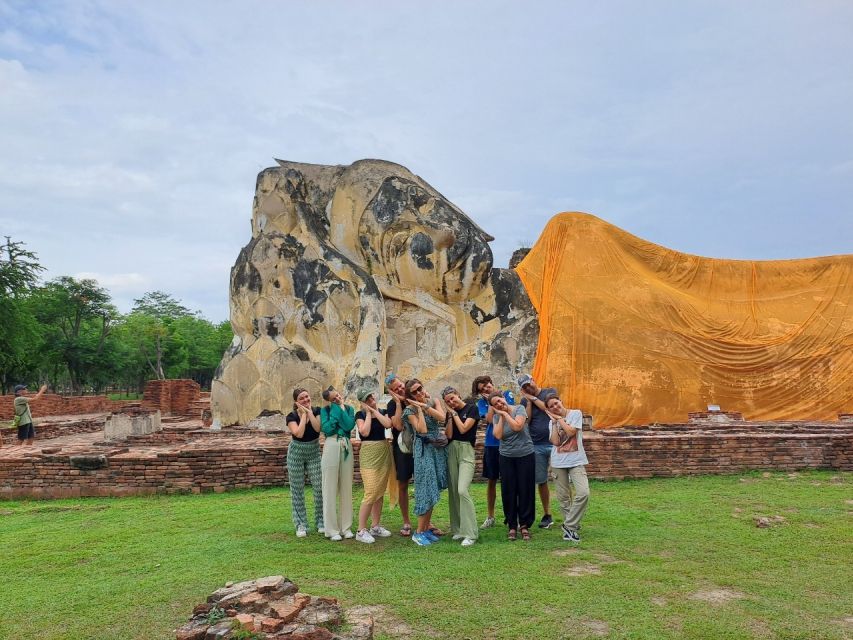
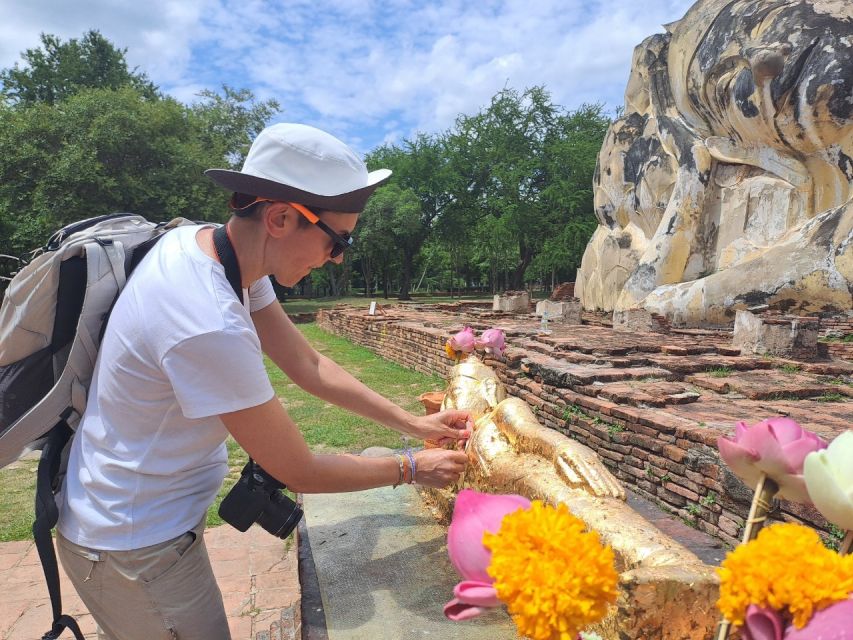
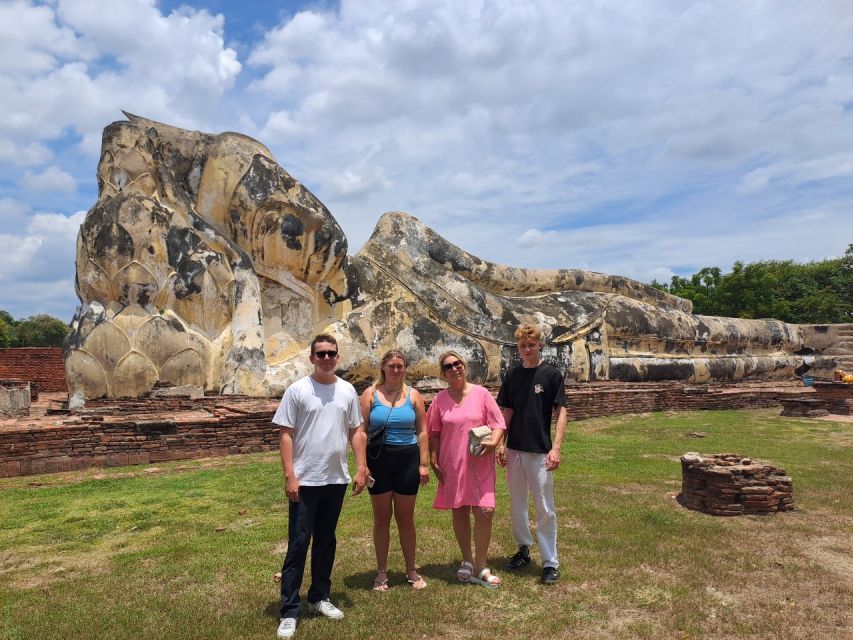
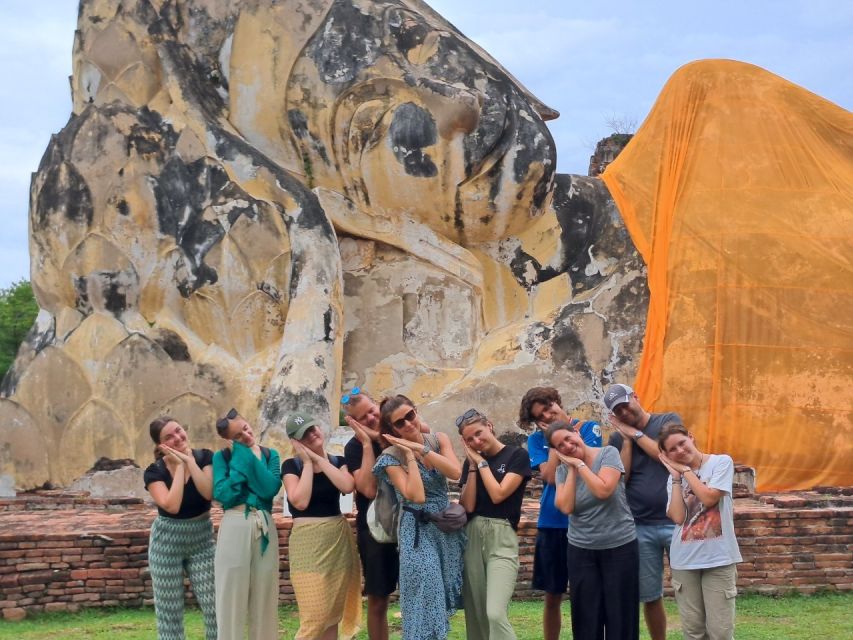
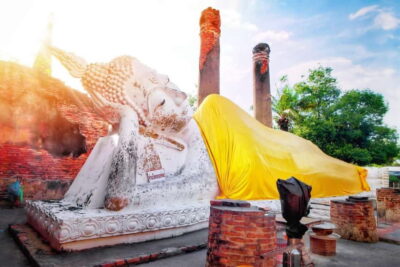
The route then reaches Luang Phor Lokayasutharam, often called Wat Lokayasutharam. Here you see the huge reclining Buddha statue, described as the largest Buddha statue in Ayutthaya.
The reclining figure offers a different kind of visual experience from Wat Mahathat and Wat Phra Si Sanphet. Instead of enclosed ruins and tall pagodas, you have a large horizontal Buddha image that is easy to grasp at a glance. The stop should be particularly memorable for anyone interested in Buddhist sculpture and religious imagery.
Wat Chaiwatthanaram on the Chao Phraya
The final major temple is Wat Chaiwatthanaram, on the west bank of the Chao Phraya River. It is often considered one of Ayutthaya’s most impressive temples, and its setting beside the water adds to the effect.
King Prasat Thong built the temple in 1630 as a memorial to his mother’s residence in the area. That detail gives the monument a personal and royal purpose, rather than leaving it as a beautiful collection of towers.
The temple’s design rewards a slower look. Notice the central structure and surrounding forms, and ask your guide about how the layout reflects Ayutthaya’s religious and royal ideals. The tour includes the entrance fee, so you can focus on the site instead of the ticket process.
One rider had the chance to be present for a special ceremony with monks during a visit. That kind of event cannot be promised, but it shows how active religious life can intersect with the old ruins. You might find the site quiet, or you might encounter a ceremony or other local activity.
The river crossing brings the day back to town
After Wat Chaiwatthanaram, you continue along the west bank of the Chao Phraya River to a pier. A boat crossing returns you toward the city, and the tour ends after you reach town.
The crossing is a practical part of the route, but it also gives the day a pleasant final change of pace. After cycling through rural roads and temple grounds, you finish on the water rather than simply retracing your route by road.
The boat crossing is included. That matters because the tour is designed as a loop rather than an out-and-back ride, giving you more varied scenery and avoiding an unnecessary repeat of the same roads.
Guides, group size, and the quality of explanations
The tour is led in English or Thai, and the group is limited to nine people. Recent guide names connected with especially positive experiences include Bung, Beam, and Spike. Bung was praised for setting a comfortable riding pace and making the history interesting. Beam was singled out for explaining Thai traditions, daily life, and local history. Spike was noted for being accommodating with family needs.
Those details tell you what to look for in the guiding style. The best version of this tour is not just a ride with occasional facts. It is a moving history lesson, with the guide explaining why a ruin matters and how it connects to Thai life.
Language clarity can vary. One rider found the explanations difficult to follow, which reduced the value of the tour. If you have trouble hearing or understanding a point, ask the guide to repeat it. A small group gives you a better chance to do so than a large bus tour.
The reported rating is 4.7 from 50 reviews, with praise focused on the guides, the relaxed group atmosphere, the well-paced cycling, lunch, and the range of stops. That is a strong overall result, but the language concern and lunch portion are worth keeping in mind.
Is the $70 price good value?
At $70 per person, the tour is not the cheapest way to see Ayutthaya. You are paying for more than a bicycle, though. The price includes a guide, bike rental, helmet, drinking water, Thai lunch, boat crossing, and entrance fees at three major temples.
The real value is the route design. You get countryside, a possible school visit, the Elephant Kraal, a market, four major temple experiences, lunch, and a river crossing in one half-day outing. Arranging all of that alone would require transport planning, entrance payments, route decisions, and a way to connect sites on both sides of the river.
I think the price makes the most sense if you want historical context and local scenery, not just transport between famous ruins. It is less compelling if you prefer to explore slowly at your own pace, spend long periods photographing one temple, or avoid cycling in warm weather.
The inclusion of three entrance fees is useful, though Wat Lokayasutharam, the market, the school visit, and the Elephant Kraal are not listed among the included paid admissions. The tour cost covers the stated inclusions, but you should not assume that every possible expense is included.
Who should book this bicycle tour?
I would choose this tour if you have one day in Ayutthaya and want a broad introduction to the city. It suits active visitors, first-time visitors who want a guide, and families with children aged 12 or older who are comfortable cycling.
It is also a good fit if you value ordinary local scenes between major sights. The rice fields, school possibility, market, village roads, and riverside meal give you a fuller picture than a temple-only route.
I would hesitate if you dislike heat, have difficulty cycling for several hours, or need a very slow sightseeing pace. The tour does not list an accessibility arrangement, and the minimum age is 12. If you are unsure about your fitness for a five-and-a-half-hour cycling day, ask the operator before booking.
Cancellation information is presented in two forms. One booking condition allows free cancellation up to 24 hours ahead, while the detailed terms say cancellation is free up to 48 hours, with a 50 percent fee between 24 and 48 hours and a full fee within 24 hours or for no-shows. Check the exact terms shown at checkout before paying.
My verdict on Colors of Ayutthaya
Book it if you want Ayutthaya to feel like a place, not just an archaeological park. The route combines the city’s best-known images with quieter roads, food, river views, and useful historical background.
The main tradeoffs are simple: you must be comfortable on a bicycle, the lunch may not satisfy a very large appetite, and guide communication can vary. For most active visitors, the small group, included costs, varied route, and strong guide feedback make $70 a fair price for a well-rounded day in the old capital.
FAQ
How long is the Colors of Ayutthaya bicycle tour?
The stated duration is 330 minutes, or five and a half hours. The tour description also refers to it as a six-hour bicycle tour.
Where does the tour meet?
The meeting point is the operator’s office near PomPhet Fort on Uthong Road, a short walk from Ayutthaya train station.
What time does the tour start?
Tours run daily from 10:00. You should check availability for the exact starting time on your chosen date.
What languages does the guide speak?
The live guide is available in English and Thai.
What is included in the price?
The price includes bike rental, a helmet, a guide, drinking water, a Thai lunch at a local restaurant, a boat crossing, and entrance fees at Wat Mahathat, Wat Phra Si Sanphet, and Wat Chaiwatthanaram.
What temples are visited?
The route includes Wat Mahathat, Wat Phra Si Sanphet, Wat Lokayasutharam, and Wat Chaiwatthanaram. Wat Mahathat is known for the Buddha head in the tree roots, while Wat Phra Si Sanphet has three distinctive pagodas.
Is the school visit guaranteed?
No. The tour visits a local elementary school if it is open, so the stop depends on the school’s availability.
What is the minimum age for the tour?
The minimum age is 12 years old.
What is the cancellation policy?
The detailed cancellation terms state that cancellations up to 48 hours before the tour are free. Cancellations between 24 and 48 hours incur a 50 percent fee, while cancellations less than 24 hours before the tour and no-shows incur a 100 percent fee. Because another booking notice states free cancellation up to 24 hours, check the final terms when you reserve.
Just added around Ayutthaya
- Bangkok to Ayutthaya Lopburi Monkey Temple, Largest Buddha Tour★ 5.0 · 62 reviews
- Sunset Sail, Glittering Tempels at Afternoon Ayutthaya Tours★ 4.5 · 25 reviews
- Private Tour: Ayutthaya Day Trip with Boat tour★ 5.0 · 75 reviews
- Day Tour From Bangkok to Ayutthaya By Bus★ 4.5 · 25 reviews
- Floating Market and Ayutthaya Guided Day Tour from Bangkok★ 4.5 · 113 reviews
- Explore Ancient Ayutthaya Historical Park Day Tour in Bangkok★ 5.0 · 10 reviews
- Explore the World Heritage Of Ayutthaya★ 5.0 · 36 reviews
- Ayutthaya, Damnoen Floating & Maeklong Railway Market Day Tour★ 5.0 · 90 reviews
Ayutthaya Tours, compared.
Ayutthaya & Ayothaya Floating Market Day Trip
Read our review →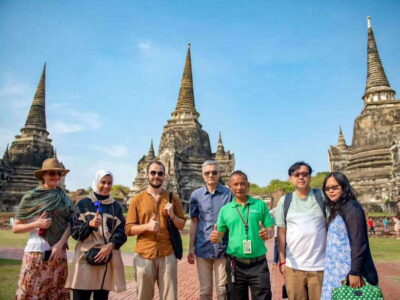
Ayutthaya Temples and River Cruise from Bangkok
Read our review →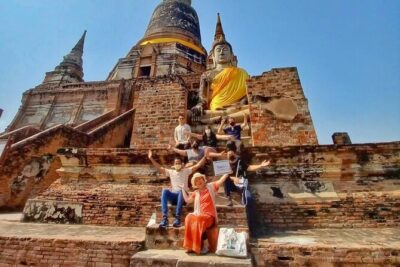
UNESCO’s Ayutthaya Historical Park: Full-Day Tour from Bangkok
Read our review →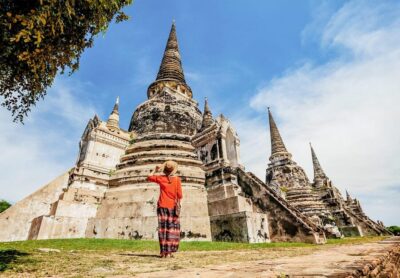
The Old Siam: Ayutthaya Temples Small Group Tour with Lunch
Read our review →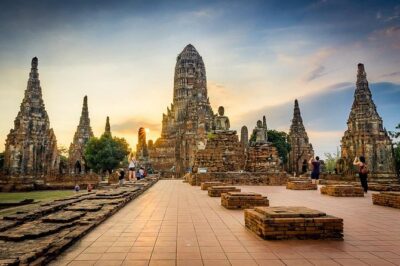
Historical City of Ayutthaya – Unesco Full Day Tour From Bangkok
Read our review →
Lopburi Monkey Temple & Ayutthaya Old City Tour From Bangkok
Read our review →Browse the lists this tour appears in