
Reviewed · CHIANG MAI TOURS
Chiang Mai Temples Visit Walking Tour with Ex-Monk Guide Part 1
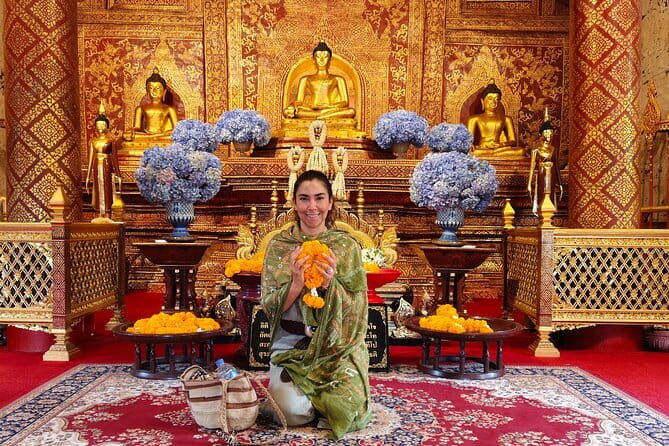
Chiang Mai’s best temple tour may be the one that explains what you are seeing, not just points at a golden roof. On this 3.5-hour walking tour, former monk Katoon leads you from Three Kings Monument to four important temples, adding Buddhist teaching, local history, and practical cultural context.
I like the former monk’s point of view, especially at Wat Phra Singh and Wat Chedi Luang, where architecture means more when you understand its place in Thai religious life. I also like the gentle pace: the temples sit close together in the old city, so the walking is light. The main consideration is that entrance fees are not included, and some travelers may find the Buddhist focus more serious than a standard sightseeing stroll.
Key points to know before you book
- Former monk Katoon leads the walk: His 18 years as a monk give the tour a personal connection to Buddhist practice, not just dates and building names.
- Four central temples in 3.5 hours: The route covers Wat Sadeu Muang, Wat Phra Singh, Wat Phan Tao, and Wat Chedi Luang.
- A strong first-day activity: Meeting at Three Kings Monument makes this a useful way to get your bearings in Chiang Mai’s old city.
- Walking is manageable: The stops are close together, and the route is described as light walking rather than a strenuous trek.
- Admission costs extra: Wat Phra Singh and Wat Chedi Luang list entrance fees, while the other named stops have free admission.
- Small enough to feel personal: The maximum group size is 20, with occasional tours made up of only two people.
Why a former monk changes the temple visit
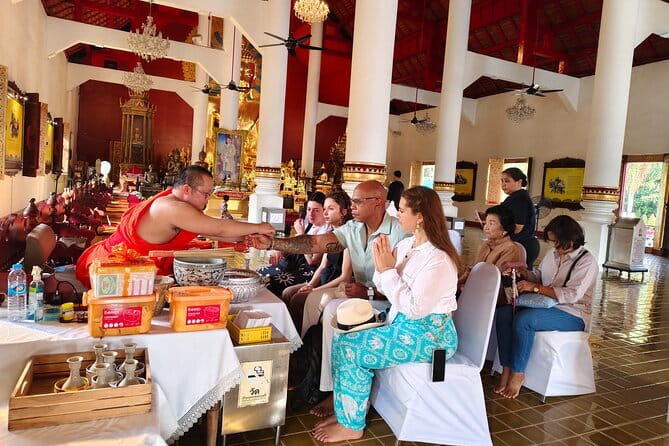
A temple tour can easily become a parade of names, dates, and photo stops. Katoon gives you another layer: what Buddhist spaces are for, how people relate to them, and why certain images or buildings matter. His former monastic life is the central reason to choose this walk over a general old-city tour.
The experience is not presented as a meditation retreat. It is a walking tour with a Buddhist theme, so you spend most of your time moving between sites and listening to explanations. Still, the subject matter can make the morning feel calm and thoughtful, especially if you want more than a quick look at ornate buildings.
The guide is described under slightly different spellings in the supplied material, including Katoon, Cartoon, and Khatom. If booking allows a guide request, ask for Katoon. The strongest praise is tied to his clear English, warm manner, detailed explanations, and ability to explain Buddhist ideas in simple terms.
He is also described as helpful with photos and patient when a participant arrived late. That does not guarantee a private tour or special timing, but it suggests a considerate style. The official guide language is English or Chinese, and the guide holds a Tourism Authority of Thailand license.
More walking tours in Chiang Mai:
- Chiang Mai: 3 Hour Old City and Temples Guided Walking Tour
★ 4.6 · 1,568 reviews - Chiang Mai: Historic Temples and City Guided Walking Tour
★ 4.7 · 650 reviews - Chiang Mai: Temple And City Walking Tour Part I
★ 4.7 · 244 reviews
Starting at Three Kings Monument at 9 a.m.
The meeting point is Three Kings Monument on Prapokklao Road in the old city. This is more than a place to gather. It gives the guide a natural opening to explain Chiang Mai and set the tone before you enter the temples.
The tour starts at 9 a.m. That is a sensible time for a walking route in Chiang Mai, since you avoid the hottest part of the day. You should still arrive ready to walk, with suitable clothing for temple visits and enough water for a 3.5-hour outing.
The guide begins with an introduction before the group sets off. This opening matters because the tour is not simply a list of four buildings. You receive a basic frame for Buddhist customs, the city’s origins, and the meaning of the places ahead.
The tour finishes back at the same meeting point. There is no hotel pickup or drop-off described, so plan your own way to Three Kings Monument and allow a little extra time to find the exact gathering spot.
Wat Sadeu Muang and Chiang Mai’s city pillar
The first temple stop is Wat Sadeu Muang, also known as Inthakhin temple in the tour description. It is presented as the place where Chiang Mai’s city pillar was first placed, right at the heart of the old city.
This is a useful opening stop because it connects religious belief with the city itself. You are not only looking at a temple compound. You are learning how a sacred site helped define Chiang Mai’s center and identity.
The planned visit lasts about 30 minutes. Admission is listed as free, so this stop adds cultural context without an extra charge.
Do not expect the most dramatic architecture of the morning here. Its value is the story and setting. Katoon’s background should be especially useful at this point, since he can explain the religious meaning behind the city pillar and how local beliefs fit within the wider Buddhist setting.
Wat Phra Singh, Lanna detail and a major Buddha image
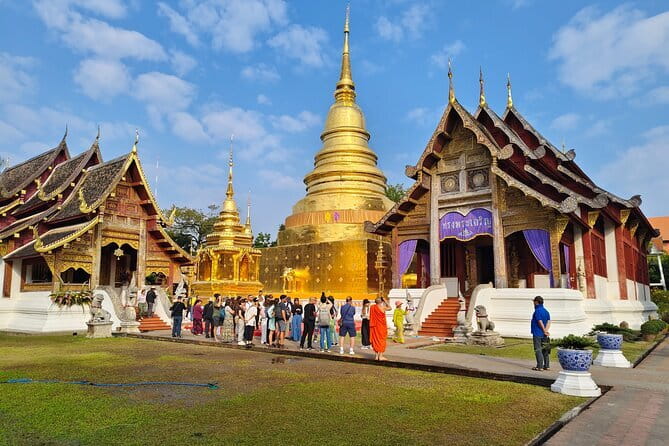
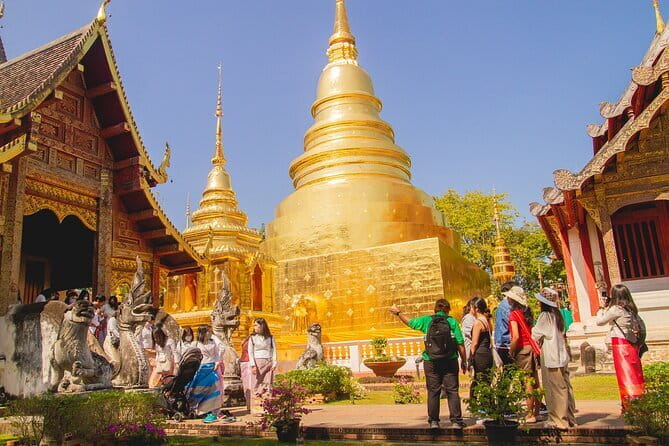
Wat Phra Singh receives the longest scheduled visit, about 45 minutes, and for good reason. Built in the 14th century, it is one of Chiang Mai’s most important temple compounds, with Lanna-style design, mosaic work, a large Lion Buddha image, and gilded details.
This is the stop where a guide can help you look past the obvious shine. The building’s decorative work is easy to admire, but Katoon can explain how the image, sanctuary, and temple grounds relate to northern Thai religious life.
The grounds also give you more to see than a single prayer hall. You might find yourself moving between architectural details, Buddha images, and the broader compound, so the 45-minute allocation should feel useful rather than rushed.
Admission is not included here. The exact fee is not supplied, so carry Thai baht and confirm the current charge when you arrive. This is one reason to budget a little beyond the $25.96 tour price.
Wat Phra Singh can be the busiest or most visually intense part of the walk, depending on the day. If you prefer quiet temples with few people, this may not be the most peaceful stop. If you want one strong introduction to Chiang Mai’s religious art, it is likely the highlight.
A few more Chiang Mai half-days worth weighing up
- Half-Day Thai Cooking Class at Organic Farm in Chiang Mai
★ 5.0 · 19,087 reviews - Chiang Mai: Elephant Sanctuary, Waterfall & Bamboo Rafting
★ 4.9 · 9,160 reviews - Chiang Mai: Doi Inthanon National Park Eco-Friendly Tour
★ 4.6 · 6,667 reviews - Chiang Mai: Elephant Sanctuary & Waterfall Group Tour
★ 4.9 · 5,780 reviews
Wat Phan Tao and the warmth of old teak
Wat Phan Tao offers a change of mood. Its main attraction is an exquisite Lanna-style ordination hall made entirely of teakwood. The building once served as a throne hall during the reign of King Mahotara Prateth, giving it a link to royal as well as religious history.
The scheduled stop is 30 minutes. That is enough time to appreciate the wooden structure and hear why it differs from the more heavily gilded temple buildings nearby.
I like the contrast here. After the colored mosaics and gold at Wat Phra Singh, the teak hall gives you a chance to notice texture, joinery, and the character of northern Thai design. This is a good place to ask the guide about the difference between a temple’s religious role and its architectural history.
Admission is listed as free. Because the site is close to the other old-city temples, you do not lose time to a long transfer. The route works best as a connected walk through Chiang Mai rather than as four unrelated stops.
Wat Chedi Luang and Chiang Mai’s largest stupa
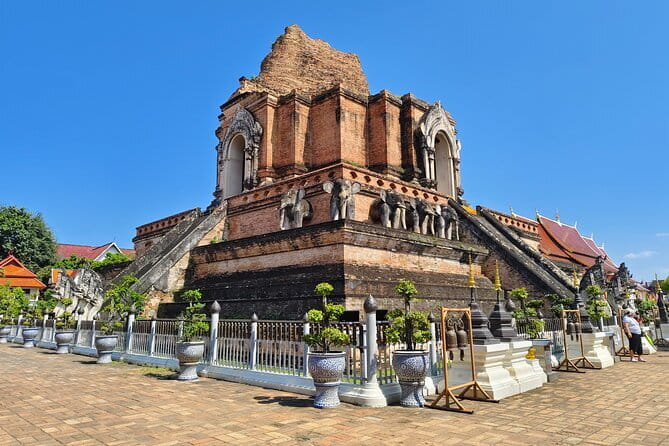
The final major stop is Wat Chedi Luang Varavihara, home to the largest stupa in Chiang Mai. The scheduled visit lasts about 45 minutes, giving you time to walk around the broad compound and examine its Lanna-style design.
The scale changes the feel of the tour. Wat Chedi Luang is less about one small detail and more about the impact of a huge central structure surrounded by temple buildings and open space. Your guide’s explanations help connect the site to Chiang Mai’s past and to the religious purpose of the complex.
Admission is not included. As with Wat Phra Singh, the current price is not provided, so treat the advertised tour cost as the guide and walking experience, not the complete cost of the morning.
This is a fitting final stop because it leaves you with Chiang Mai’s most imposing temple structure. It also gives the guide room to bring together the themes introduced earlier: Buddhist practice, Lanna architecture, local history, and the role of sacred places in city life.
What the $25.96 price really covers
At $25.96 per person, the tour is priced as an affordable guided experience rather than a premium private outing. The real value lies in the guide’s interpretation. If you only want to photograph temple roofs, you can visit these areas on your own. If you want someone to explain Buddhist ideas and cultural details as you go, the fee is easier to justify.
The price includes an English or Chinese-speaking licensed guide. It does not include entrance fees, and those extra costs apply at Wat Phra Singh and Wat Chedi Luang. Since the exact admission amounts are not stated, you should keep some money available rather than assuming the advertised price covers everything.
The group can reach 20 people. That is still a manageable maximum for a walking route, but the experience will feel different with 20 people than with a couple or a very small group. Some departures may be smaller, and the personal feel will depend on the final group size.
There is no transport between stops because the route is designed for walking. That keeps the cost down and lets you see the old city in sequence. It also means you should choose comfortable footwear and be prepared to spend several hours on your feet.
The right pace for an old-city morning
The full experience lasts about three hours and 30 minutes. The listed stop times add up to roughly three hours, with the remaining time used for walking, introductions, transitions, and questions.
That pacing sounds reasonable for four temples. You get about 30 minutes at the smaller or more focused stops and 45 minutes at the larger compounds. You are unlikely to feel trapped at one site for too long, yet you have enough time to listen and look around.
This is not a rapid checklist. The guide’s value depends on taking time to explain details, and the route allows for that. The walking itself is described as light because the temples are close together, though heat, crowds, and temple surfaces can still affect how tiring the morning feels.
The 9 a.m. start is also practical for a first day in Chiang Mai. You can learn the old city’s layout, understand basic temple etiquette, and finish near the original meeting point with much of the day still available.
Buddhist learning without the pressure of a retreat
The tour’s main subject is Buddhism, including its history, philosophy, practices, and role in local culture. You should book it if you want to understand why people visit temples and how religious ideas shape the buildings and customs you see.
The former monk perspective is particularly useful for questions that a general guide might answer only in broad terms. You can ask about the meaning of images, the purpose of different spaces, and the difference between seeing a temple as an art site and approaching it as a place of worship.
The tour may also appeal to you if you are looking for a quieter, more reflective morning. It does not promise a formal meditation session, and meditation is not listed as a scheduled activity. The Buddhist theme is educational and cultural, with personal reflection as a possible benefit rather than a fixed part of the program.
You should also keep an open mind about the subject. If your main goal is food, markets, shopping, or Chiang Mai nightlife, this tour will not cover those interests. It stays focused on temples, Buddhism, local culture, and history.
Temple etiquette and practical planning
Temple visits require respectful dress and behavior, though specific clothing rules are not provided in the tour details. The safest approach is to wear clothing that covers your shoulders and knees and to follow the guide’s instructions at each site.
Because admission fees are extra, bring some cash. The tour is close to public transportation, but you must make your own way to Three Kings Monument. The meeting point is also the end point, which simplifies your plans after the walk.
Confirmation is received at booking. The activity is suitable for most people, and the stated group limit is 20. No special accessibility details are provided, so anyone who needs specific mobility information should check with the provider before paying.
The experience requires good weather. If poor weather cancels the tour, you are offered another date or a full refund. You can cancel for a full refund up to 24 hours before the start time, but changes or cancellations inside that 24-hour window are not accepted.
Who will get the most from this tour
I would choose this walk for a first morning in Chiang Mai, especially if I wanted a clear introduction rather than a self-guided tour with a map. It suits solo visitors, couples, and small groups who enjoy asking questions and learning the meaning behind what they see.
It is also a strong fit for anyone curious about Buddhism but unsure where to begin. Katoon’s former monastic experience gives the tour a personal angle, while the four stops provide enough architecture and history to keep the morning varied.
Families and older participants may appreciate the short distances between temples, although the total experience still involves several hours of walking. Anyone seeking a private guide should understand that the group can include up to 20 people, so a private feel is not guaranteed.
I would be less likely to choose it if I had already spent several days visiting temples and wanted something entirely different. I would also compare the extra entrance fees and group size with a private option if I wanted a highly tailored route.
Should you book the Chiang Mai temple walk?
Book it if you want Chiang Mai’s temples explained by someone with firsthand monastic experience. The strongest reasons are Katoon’s clear communication, his warm and patient manner, and the chance to connect Buddhist teaching with specific buildings and local history.
The price is fair for a licensed guide and a well-paced old-city route, but remember that entrance fees are separate. Ask for Katoon by name if possible, arrive at Three Kings Monument before 9 a.m., dress respectfully, and carry water and cash.
Skip it if you only want quick photographs or if you prefer a fully private tour with no chance of a larger group. For most first-time visitors who want an informed, gentle introduction to Chiang Mai’s spiritual center, this is a worthwhile half-day choice.
FAQ
Where does the Chiang Mai temple walking tour start?
The tour starts at Three Kings Monument on Prapokklao Road in Chiang Mai’s old city.
What time does the tour begin?
The scheduled start time is 9 a.m.
How long does the tour last?
The tour lasts approximately three hours and 30 minutes.
Which temples are included?
The route includes Wat Sadeu Muang, Wat Phra Singh, Wat Phan Tao, and Wat Chedi Luang Varavihara.
Does the tour include temple entrance fees?
No. Entrance fees are not included. Wat Phra Singh and Wat Chedi Luang list admission as not included, while Wat Sadeu Muang and Wat Phan Tao list free admission.
Who guides the tour?
The tour includes an English or Chinese-speaking guide with a TAT license. The guide is identified as Katoon, with some supplied comments spelling the name as Cartoon or Khatom. He is a former monk who spent 18 years in the monkhood.
How large can the group be?
The maximum group size is 20 people.
Can I cancel for a full refund?
Yes. You can cancel at least 24 hours before the experience start time for a full refund. Cancellations or changes made less than 24 hours before the start are not accepted, and poor-weather cancellations offer a different date or a full refund.
Just added around Chiang Mai
- Wat Phra That Doi Suthep & Wat Pha lat Evening Tour & Guide★ 4.5 · 89 reviews
- Walk With Monks Collecting Alms(meeting point maybe change)★ 4.9 · 8 reviews
- Chiang Mai: Doi Inthanon Park Day Trip with Kiw Mae Pan Hike★ 4.6 · 75 reviews
- Chiang Mai Zipline White Water Rafting and Elephant Sanctuary★ 4.0 · 11 reviews
- Zipline+Sticky waterfall+Long Neck Village Private Tour★ 5.0 · 22 reviews
- Chiang Mai Airport Private Transfer – Hotel or Airport★ 4.5 · 51 reviews
- Trek to a Jungle Waterfall★ 5.0 · 14 reviews
- Zipline Adventure at Skyline Jungle Luge Chiang Mai★ 5.0 · 102 reviews
Chiang Mai Tours, compared.
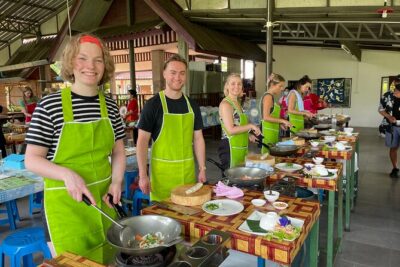
Half-Day Thai Cooking Class at Organic Farm in Chiang Mai
Read our review →
Elephant Sanctuary, Waterfall & Bamboo Rafting
Read our review →

Chiang Rai Temples, Karen Tribe and Hot Springs
Read our review →
Cooking Class, Market & Thai Herbs Garden Tour
Read our review →
Authentic Cooking Class with Market & Farm Visit
Read our review →
Elephant Sanctuary Feeding Program Half-Day Tour
Read our review →Browse the lists this tour appears in